

It always starts the same way. Someone in the group chat says “we should do a charity match for that”, everyone agrees, and then there's a silence - because now somebody has to actually organise it and kit the teams out...
If that somebody is you: good news. A charity match is one of the best things a community can do with a football pitch, and it's far more doable than it looks. Here's the whole job, step by step.
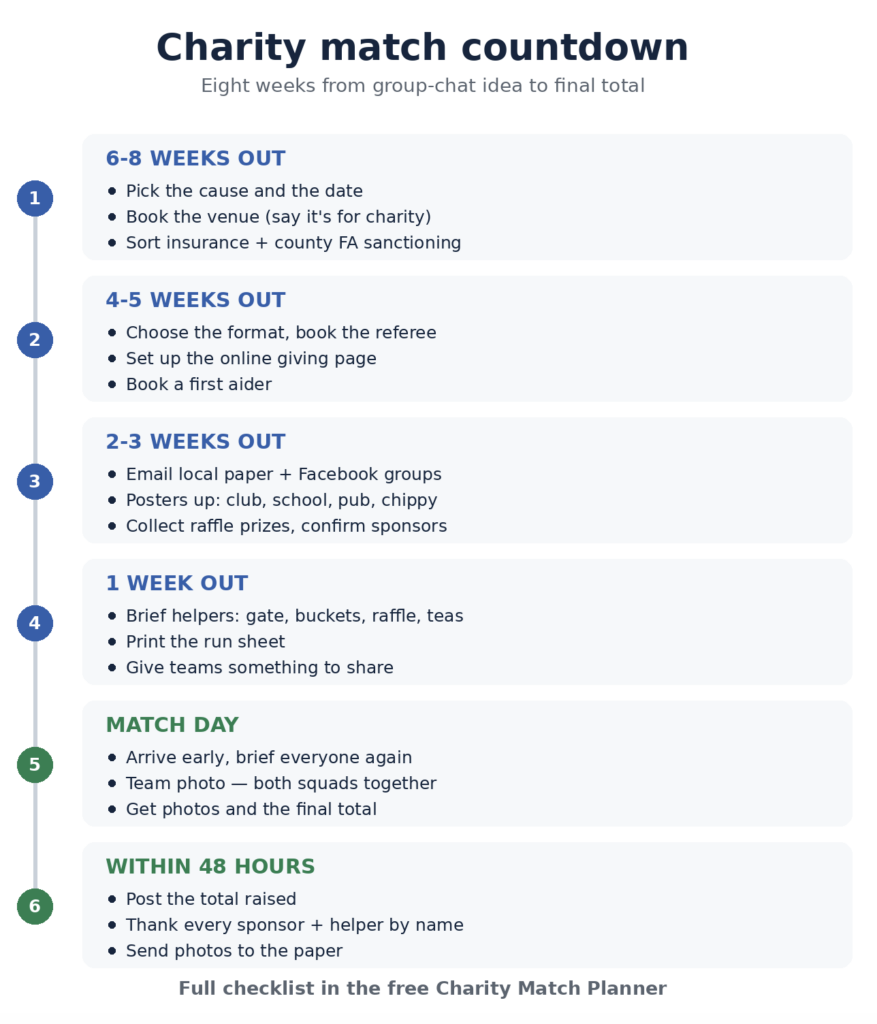
Step 1: Pick the cause, then pick the date
The cause usually picks itself - that's why you're here. Make it specific and personal where you can: “for Sam's rehab” or “for the local food bank” will always out-raise “for charity”.
Then give yourself six to eight weeks. Check the date against local fixtures, school holidays and anything else your crowd would rather be at. Sunday early afternoon is the sweet spot - players are free, families can come, and the pub is open after.
Step 2: Sort the venue
Your options, in rough order of cost: a club's home ground (often free or cheap if the cause is local - just ask), a school or college 3G (great in winter, book early), or council pitches through your local authority. Whoever you book with, tell them it's a charity event - many venues will discount or donate the hire, and that's your first sponsorship win before a ball's been kicked.
Step 3: Insurance and permissions - the boring bit that isn't optional
Two questions to ask before anything else. Does the venue's insurance cover your event, or do you need your own public liability cover? And if you're using an affiliated club's facilities, does the match need sanctioning through the county FA? Neither is difficult - both are much easier six weeks out than six days out. Your venue and county FA will tell you exactly what they need.
While you're at it: first aid. At minimum, a qualified first aider and a kit on site. Many local providers offer charity rates.
Step 4: Pick a format everyone can play
An 11-a-side slog in July heat is nobody's fundraiser. Think about who's actually turning up: mixed-ability 7-a-side works almost everywhere, a round-robin of short games gets more people (and more donations) involved, and legends vs current squad sells itself. Walking football brings in a generation who'd otherwise stand on the sideline holding the bucket.
Book a referee through the county FA or a local league - and pay them, even for charity. Some will donate the fee back; that's their call to make, not yours.

Step 5: Raise actual money, not just goodwill
A well-attended match that raises £40 is a lovely afternoon and a wasted opportunity. Stack up several small earners rather than relying on one:
- Online giving page - set this up first. It's where every poster, post and programme should point, it takes money from people who can't attend, and it handles Gift Aid for you.
- Player entry donations - a fiver to play is a fiver nobody misses.
- Raffle of donated local prizes - ask every business on the high street; the worst they say is no.
- Bucket collection at the gate.
- Teas and a barbecue.
- Match sponsorship - local businesses will happily put their name on the day, the trophy, or even the man-of-the-match award.
Announce a fundraising target. “Help us hit £1,000” turns spectators into participants.
Step 6: Promote it like it matters - because it does
You have something local journalists genuinely want: a real community story. Email the local paper and community Facebook groups two to three weeks out with the story (the cause, not the football), the date, and the giving page link. Posters in the club, the school, the pub and the chippy still work better than anyone admits. And give the teams something to share - people promote things they're playing in.
Step 7: Match day
Arrive early, brief your helpers (gate, buckets, raffle, teas), and get a team photo of everyone - both squads together, not apart. It's a charity match; the rivalry is the entertainment, not the point.
Most importantly: get photos and the final total. Which brings us to…
The bit everyone forgets: afterwards
Within 48 hours, post the total raised, thank every sponsor and helper by name, and send the photos to the paper as a follow-up story. This is what turns a one-off match into an annual fixture - and year two is half the effort for twice the money.
Get the whole plan on one page
We've put everything above into a free planner - an eight-week countdown checklist, a fundraising tally sheet and a match-day run sheet - so you can stick it on the fridge and stop holding it all in your head.
Download the free Charity Match Planner (PDF)
- no design skills, no committee meetings, just a plan.
Related reading
- Kitting out both squads? Design yours in minutes with the Bausatzhersteller.
- Approaching local businesses? Use the Kit Funder sponsor pitch template.